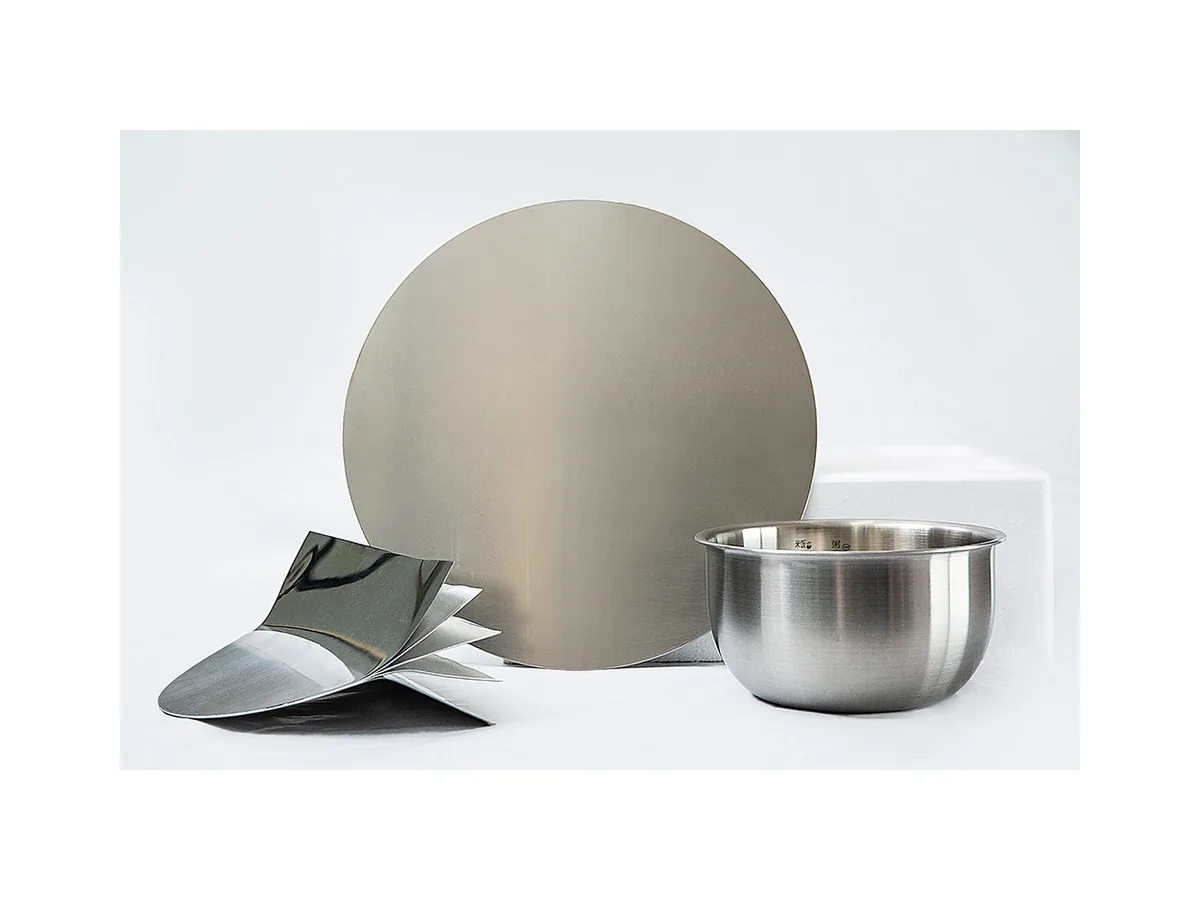
Blanking clad circles: the nest decides what you pay
A circle looks like the simplest part in the plant and carries three variables that decide its cost: the nest, the tooling and the tolerance on the diameter.
At a glance
Specification at a glance
| Variable | What it does | What to specify |
|---|---|---|
| Nest pattern | Decides how much sheet becomes scrap | Diameter and quantity; the supplier optimises the nest |
| Blanking tooling | Sets the available diameter and the edge quality | Diameter, tolerance, deburr or not |
| Diameter tolerance | Moves press fit and scrap rate at your end | Nominal plus minus, pre-press or finished |
| Flatness | Decides whether the disc sits flat in the die | Millimetres over the disc, 24 hours after cutting |
| Edge condition | Decides whether a separation starts in the draw | Sheared, deburred or rolled |
| Count per stack | Decides handling at your press | Pieces per stack, interleaving |
The nest is invisible in the price
When a supplier quotes a disc price, the web between discs is already in it. A nest that fits ten discs where another fits twelve changes the price by a few percent without changing the material at all. Large diameters and unusual tooling reduce the options the supplier has.
That is why a diameter that is close to stock tooling is often cheaper than a bespoke one, even before the tooling cost is counted.
Edge quality is a drawing decision
A sheared edge is fast and leaves a burr. A deburred edge costs a pass and protects the draw. For a part that is deep drawn, the deburr is normally worth it; for a part that is only flanged, it usually is not.
Write which one you want. A drawing that does not say gets the cheaper default.
Flatness after cutting
Blanking releases stress, so the disc that is flat on the pallet can be dished the next morning. Flatness therefore belongs on the disc, measured after a day, on pieces from the middle of the stack. The supplier can only hold a flatness figure they are measuring.
Packing for a press, not a warehouse
Count per stack matters when the operator feeds from a fixed stack. Interleaving matters when the cooking face must stay unmarked. Neither costs much to specify and both are annoying to discover at destination.
What to put on the drawing
Diameter and tolerance, pre-press or finished, thickness and tolerance, flatness limit and the timing, edge condition, surface, count per stack, interleaving, and the batch reference on the label. That is the whole specification for a disc, and it fits on one page.
Questions
Common questions
What diameters can you blank?
The limit is the tooling and the nest rather than the material. Send the diameter and the volume and the cutting route is confirmed with the quotation.
Is a deburred edge worth the extra cost?
For deep-drawn parts, usually yes: a burr is where a separation starts. For flanged parts, a standard sheared edge is normally enough.
Can you cut a diameter outside your standard tooling?
Yes, with new tooling, which carries a one-off cost. A diameter close to existing tooling avoids it.
How is the disc counted and packed?
To a count per stack, interleaved where the face must stay unmarked, strapped and labelled with the batch reference.
Why do my discs arrive dished?
Residual stress released by cutting, usually an anneal issue. It is specified and checked as flatness on the disc after 24 hours.