Process
How clad metal is bonded: roll bonding versus explosion welding
Every clad product depends on one decision made before anything else: how the layers are joined. The two industrial routes differ in thickness range, output and what the interface looks like.
Two routes, one objective
The objective is the same in both cases: bring two dissimilar metals close enough, under enough pressure and temperature, that they join at the atomic level without a glue layer in between. The routes differ in how that pressure is delivered.
Explosion welding uses a detonation to drive one plate into another at an angle at very high speed. Roll bonding reduces a stacked pack between rolls under heat, so the layers thin together and the interface becomes a metallurgical bond. A third family, solid-liquid and diffusion bonding, exists for special cases but is not how cookware material is made at volume.
Explosion welding: thick plate, low output
In explosion welding the flyer plate is placed at a standoff above the base plate and covered with explosive. The detonation accelerates the flyer across the gap; the collision produces a jet that strips the surfaces clean and a pressure wave that welds them. Under good conditions the shear strength at the interface can reach the order of 400 MPa, which is why the route is trusted for heavy plate.
Its limits are practical. It is a cold process, so it will bond combinations that heat would ruin, including titanium and copper. It handles total thicknesses in the hundreds of millimetres, which suits tube sheets and large bases. It is not suited to thin material: below roughly 10 mm total thickness the geometry stops working. It is also a batch process with weather, noise and vibration constraints, so output is low and lead times are long.
Roll bonding: what cookware actually uses
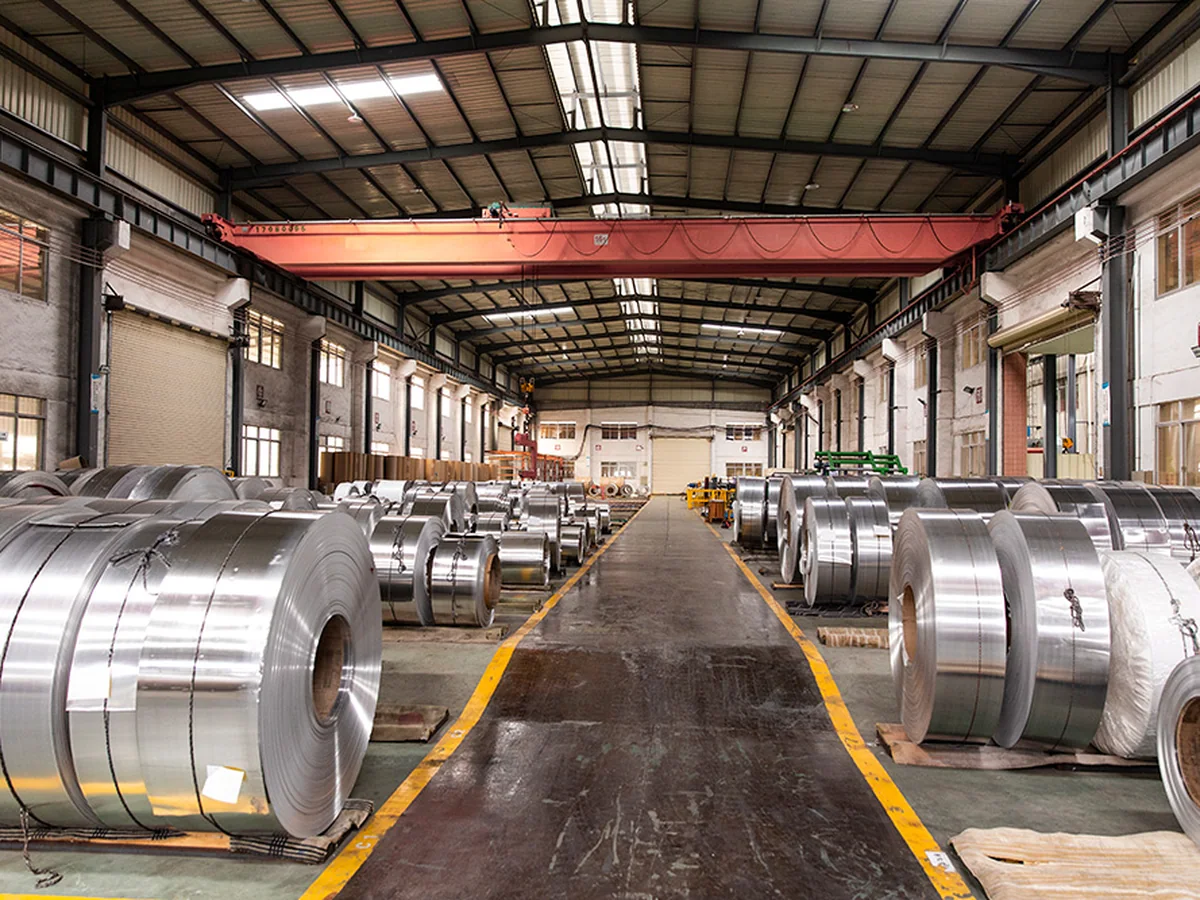
Cookware clad is roll bonded. A pack is assembled, heated, and reduced on a rolling mill until the layers are bonded and the target thickness is reached, then annealed and leveled. The route suits the product for three reasons: it produces thin sheet economically (cladding layers of 0.5 mm and above are routine), it holds thickness tolerance across a wide sheet, and it produces a flat product that a press can use directly.
The trade-off is capital. A rolling line is expensive, which is why the number of plants able to run multi-layer cookware clad at volume is small compared with the number of explosion welders. For a buyer, that concentration is useful information: the plant either has the line or it does not, and a visit settles it in ten minutes.
What the standards cover, and what they do not
Explosion-welded stainless clad plate is specified in China under GB/T 8165, which follows JIS G3601 in substance. Those standards are written for clad plate on a carbon steel base, with shear and bend tests defined for that geometry. Cookware clad is a different animal: thin, symmetrical, often with an aluminium core, and judged by how it behaves in a press and in a pan rather than by plate-test criteria.
That is why a mill test certificate quoting a plate standard is not by itself evidence that a cookware structure is right. What matters is the bond test method agreed for the order, the acceptance criteria, and whether they were applied to the batch in front of you.
Questions that separate suppliers
Ask which route the structure is made on, and whether the plant owns the line. Ask what bond test is run, on what frequency, and what the acceptance criterion is: peel, shear or bend, and at what value. Ask how the cut edge is treated, because a sheared edge on clad is where separation starts if the bond is marginal. Ask whether the bond line is inspected visually or by a method that can see a void. A supplier who answers all four without a meeting is a supplier who runs the process rather than trading it.
Questions
Common questions
Is explosion-welded clad used for cookware?
Rarely. Explosion welding is not suited to thin material, and cookware clad is thin. It is used for heavy plate such as tube sheets and large bases.
How thick can the cladding layer be?
With roll bonding, stainless cladding layers of 0.5 mm and above are routine, with the core thickness set by the thermal requirement of the cookware.
What bond strength should I specify?
Specify the test method and the criterion rather than a number copied from another product. Peel, shear and bend tests measure different things, and a value that is right for clad plate is not automatically right for a 2.5 mm cookware sheet.
Does the bond fail at the cut edge?
A sound bond does not. Edge separation is a symptom of a marginal bond or poor edge quality, which is why edge condition belongs in the specification alongside bond strength.
Why does the number of plants matter to a buyer?
Because roll-bonding lines are capital-intensive and uncommon. A trader can quote any structure; only a plant with the line can hold a thickness tolerance across a run.