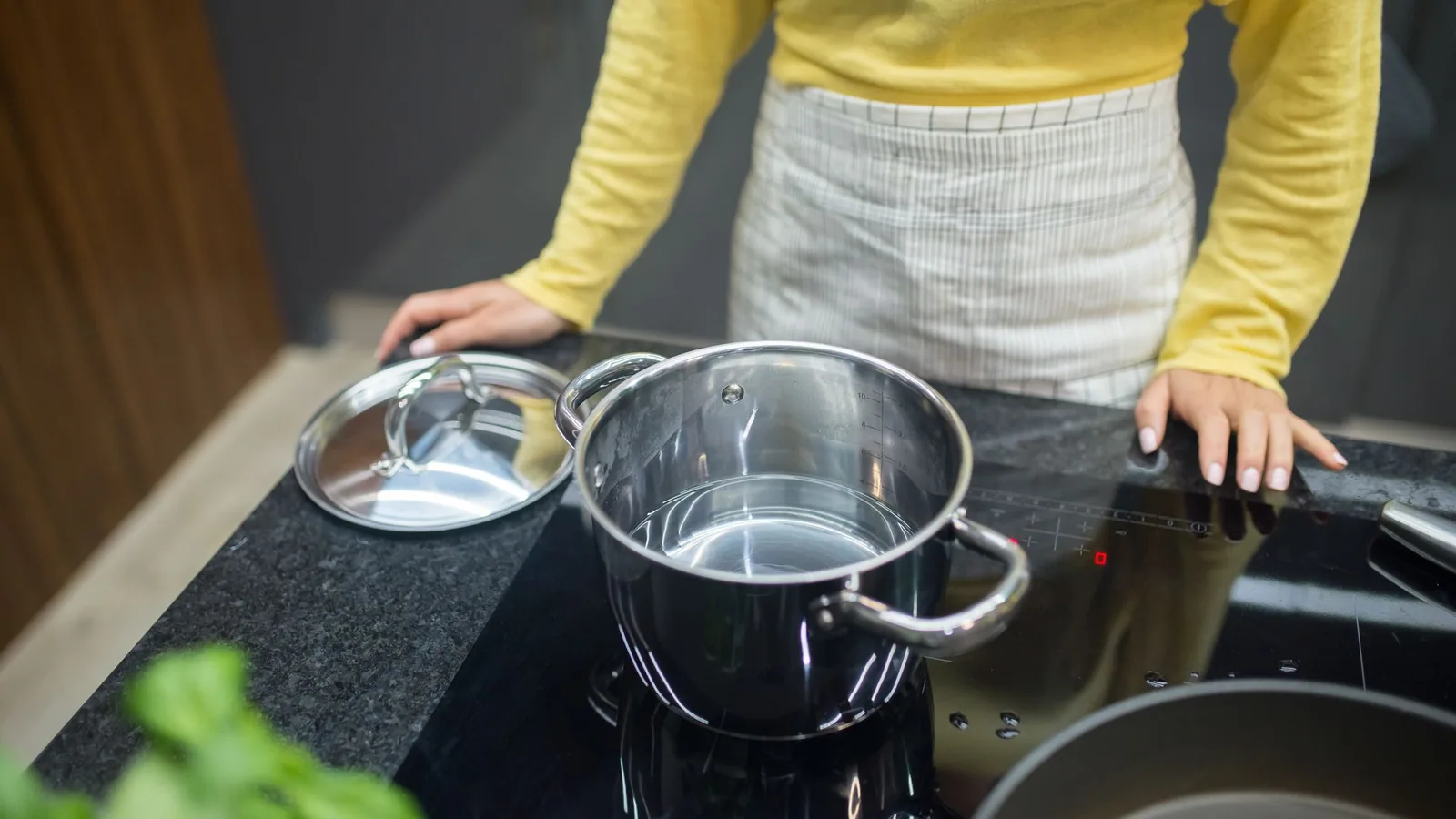
Clad metal for induction cookware
An induction hob does not heat the pan, it heats the pan's base by magnetic coupling. That is why the hob-facing layer of a clad structure is a magnetic stainless such as SUS430, and why the layer choice is a functional requirement rather than a preference.
At a glance
Specification at a glance
| Layer | Grade | Function in an induction pan |
|---|---|---|
| Cooking face | SUS304 | Food contact, corrosion, cleaning |
| Core | AL1050 | Heat spread from the base to the wall |
| Hob face | SUS430 | Magnetic coupling with the induction coil |
| Base flatness | Measured on the finished pan | Contact with the glass surface |
| Validation | Induction test on the assembled pan | Confirms the design, not only the sheet |
Why the outer layer is magnetic
Induction coils generate a changing magnetic field, and a ferromagnetic material in that field develops eddy currents and heats. Austenitic stainless such as 304 is very weakly magnetic when annealed, so a 304 back face couples poorly with the coil. Ferritic stainless such as 430 is magnetic, couples well, and costs less than a 300-series face.
That is why the standard Huahao structure is 304 on the cooking face and 430 on the hob face. Both faces are stainless, but they are there for different reasons.
What the finished pan has to prove
The material can be right and the pan still fail induction testing. Coupling depends on the base geometry, the thickness of the magnetic layer, the distance between the coil and the base, and the flatness of the base against the glass. A pan with a dished base will heat slowly however good the sheet is.
So induction performance is validated on the assembled cookware, on the hob the product is sold for. The material specification gives the starting point; the test gives the answer.
Specifying an induction body
Send the pan drawing, the hob type and the target performance, and the plant confirms the magnetic layer and the total thickness. If the design puts the magnetic layer only in a base plate rather than the full body, say so, because that changes the blank and the welding or bonding step.
For a range that also has to work on gas, the same three-ply structure covers both, which is why it dominates the market rather than a dedicated induction-only material.
Questions
Common questions
Can a 304 + 1050 + 304 pan be used on induction?
Only if a magnetic element is added, because an annealed 304 face couples weakly. The standard structure uses 430 on the hob face for that reason.
Is 430 food safe?
It is on the hob face, not the cooking face. The cooking face is 304, and the food-contact reports apply to the grades in that position.
Does the magnetic layer thickness matter?
Yes. The thickness and the base geometry both affect coupling, which is why induction performance is validated on the finished pan rather than on the sheet alone.
Do you supply material for induction base plates only?
Base plates are discussed per project. Send the design and say whether the magnetic layer is a full body or a base insert.
Will the same material work on gas and induction?
Yes, a three-ply structure with a 430 back works on both, which is why it is the standard for ranges sold across hob types.