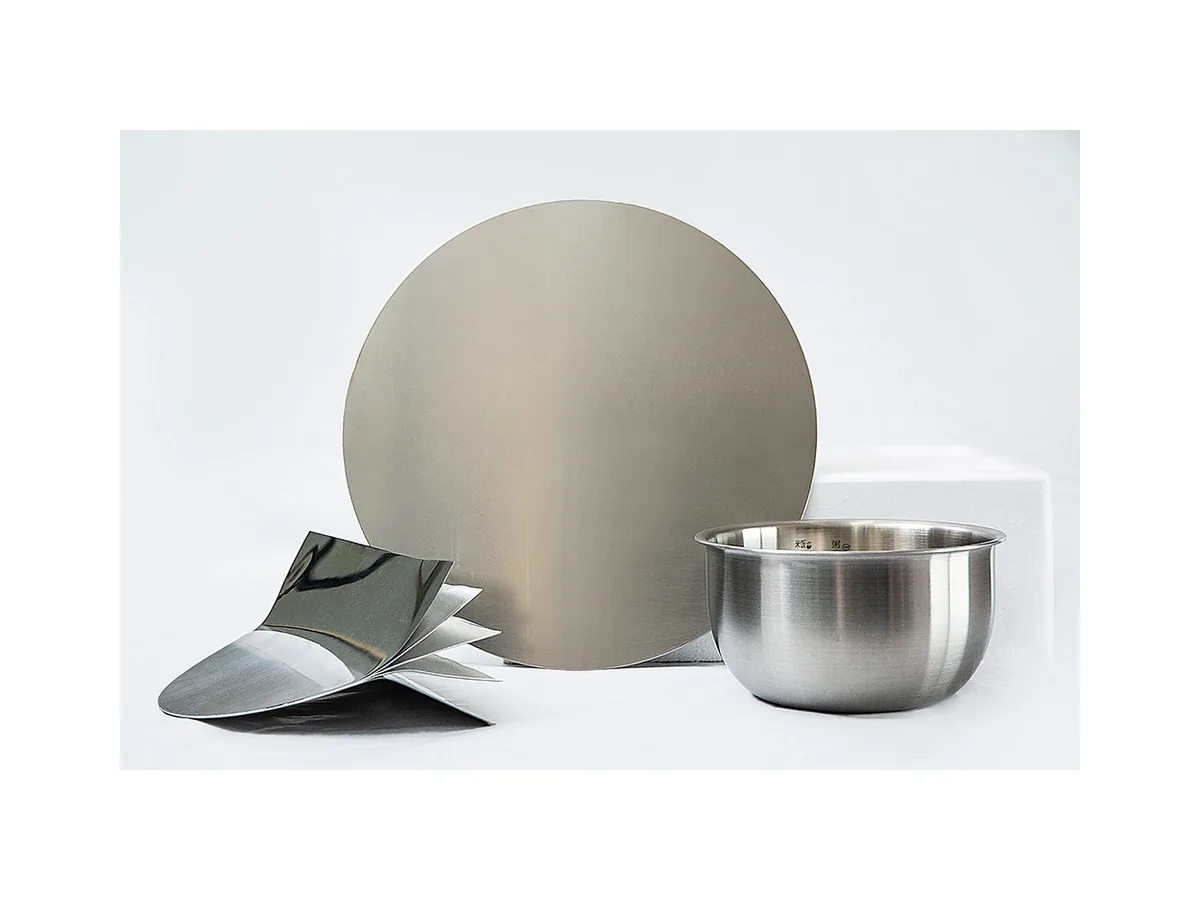
Samples and trial runs: what a sample proves, and what it does not
A sample confirms a grade and a finish. A trial confirms a structure. Buyers who skip the second step often discover the difference in the first production run.
At a glance
Specification at a glance
| Stage | What you receive | What it settles | What it cannot settle |
|---|---|---|---|
| Sample disc | A few pieces with batch documents | Grade, surface, thickness, edge | Draw behaviour at volume |
| Sample sheet | A cut piece of the sheet | Flatness, surface, gauge | Press behaviour |
| Forming trial | Enough discs for a full setup and a short run | Wrinkling, thinning, delamination, tooling fit | Long-run consistency |
| First production lot | The order quantity | Everything, including the supplier's consistency | Nothing, by then it is committed |
Why a sample is not a trial
A sample is a material statement: this is the grade, this is the finish, this is the thickness. It is not a forming statement, because it was not drawn in your tooling. Buyers regularly approve a sample, order a container, and discover the material wrinkles in their press.
The trial is the step that answers the press question, and it costs a fraction of the container.
How many pieces a trial needs
Enough for a full press setup plus a short run: the number depends on the press, the die and how many parts are scrapped during setup. Ask your press operator, not the supplier. The material for a trial should come from the same anneal as the intended production, otherwise the trial tests a different material.
What to record during the trial
Record the setup parameters, the parts produced, the failures and the failure mode: wrinkling at the flange, thinning at the wall, edge separation, dishing after forming, or orange-peel from grain. Photograph the failures. That record is what turns a trial into a specification, because it tells the supplier which variable to change.
Documents that should travel with a sample
A sample without a batch reference cannot be compared with production. Ask for the label reference, the mill certificate for the coil, and the inspection record for the batch. Then keep the sample: when a later batch behaves differently, the retained sample is the evidence.
How to make the decision
Approve the structure when the trial parts meet the drawing and the failure rate is acceptable to your production team. Approve the supplier when the first production lot matches the trial. Those are two decisions, and a supplier who treats them as one is asking you to take the risk.
Questions
Common questions
How many samples can I get?
A small batch for evaluation, normally a few discs or a piece of sheet. The quantity and the cost are quoted with the request, because a sample is a production run in miniature.
Do samples come with certificates?
They should. Ask for the batch reference, the mill certificate and the inspection record; a sample without them cannot be traced to a production lot.
Can you form the trial parts for me?
We can supply the material and, where a partner tooling exists, arrange a forming trial. Your own tooling is always the better test.
What if the trial fails?
The failure mode tells you which variable to change: anneal, edge, gauge or tooling. That is the value of the trial, and it is cheaper than discovering it in a container.
How long does a sample take?
It is quoted with the sample request. Cutting a few discs from stock is fast; a new structure or a new pattern takes longer and is scheduled.