
Quality
Common clad metal defects and what causes them
Most clad complaints fall into six categories. Each has a process cause and a check that finds it before the press does.
At a glance
Specification at a glance
| Defect | What you see | Usual cause | Where to catch it |
|---|---|---|---|
| Edge separation | Layers lifting at the cut edge | Marginal bond or poor edge quality | Shear test on strips from the coil edge |
| Waviness | Sheet will not sit flat | Residual stress not relieved | Flatness check after annealing, before packing |
| Thickness drift | Disc weight varies along the coil | Roll gap or temperature drift | Thickness scan at head, middle and tail |
| Intermetallic growth | Brittle bond line, cracking in drawing | Excess time at temperature | Hold time control and bond micro-check |
| Roll marks and inclusions | Lines or dark specks on the face | Mill condition or a dirty pack | Visual inspection after leveling |
| Delamination after drawing | Bond fails in the press, not before | Edge condition plus a marginal bond | Bend test plus a trial pressing |
Start with what a defect tells you
A clad failure is a message about the process, not a random event. Edge separation points at the bond and the shear. Waviness points at the anneal. Thickness drift points at the mill. Reading the defect correctly converts a complaint into a control point, and the six below cover most of what buyers report.
Edge separation
The layers separate at the cut edge, sometimes by a fraction of a millimetre, sometimes enough to see light through. It comes from a bond that is marginal near the edge of the coil, or from a shear that tears rather than cuts. Check it with a strip taken from the coil edge, sheared and bent: if the layers lift, the bond at the edge is the problem, not the disc.
Waviness and flatness loss
Sheet that will not sit flat after cutting is usually stress that was never relieved. The anneal either did not happen, ran outside its band, or cooled too fast for the layer thickness. Catch it by measuring flatness after annealing and again 24 hours after cutting a blank, because part of the movement only appears once the sheet is released.
Thickness drift along the coil
Discs from the head and the tail of the same coil weighing differently is a mill problem: roll gap, temperature or speed drifting during the pass. The check is a thickness scan at three positions per coil and a weight check on the finished discs, both recorded against the batch.
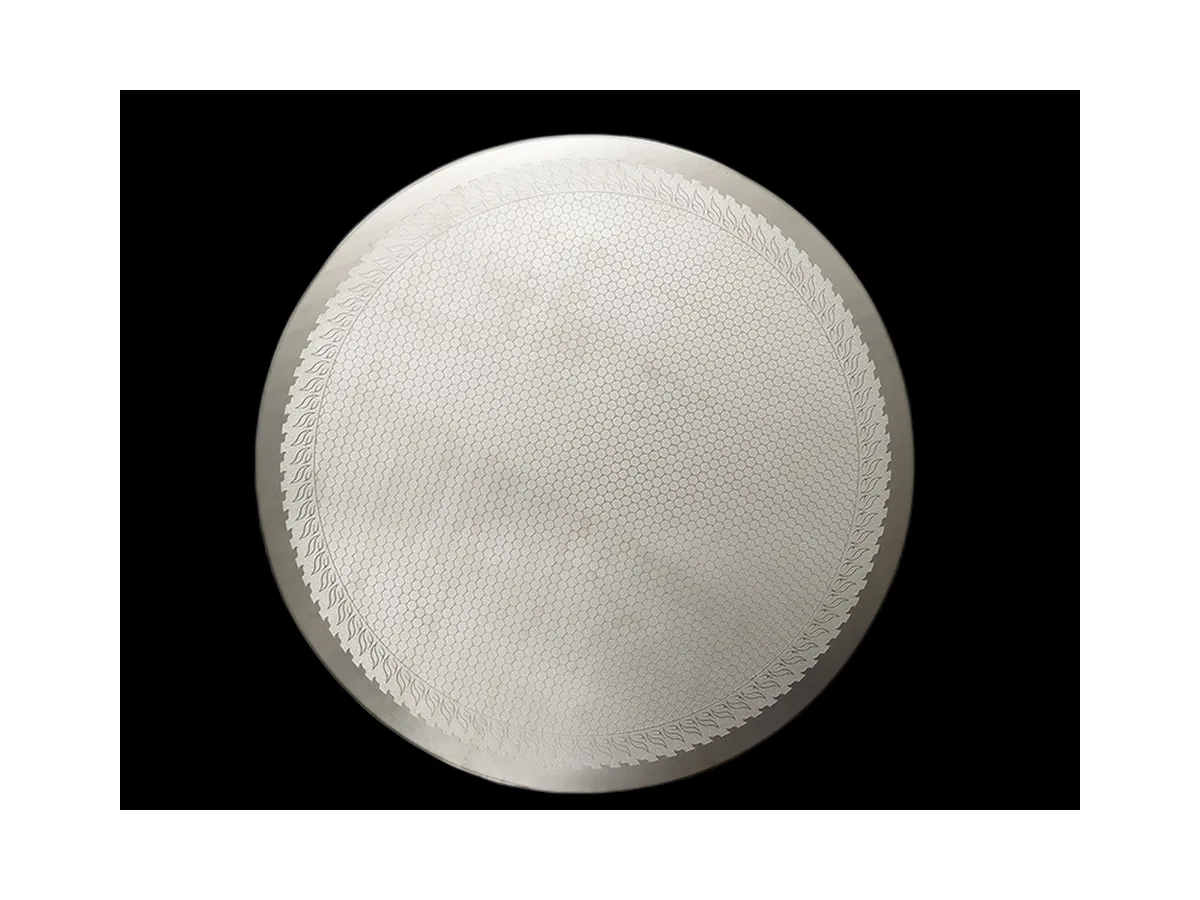
Intermetallic growth at the bond line
Held too long at temperature, aluminium and stainless form a brittle intermetallic layer at the interface. It passes a peel test when cold and fails in a deep draw, which is why the hold time in the anneal is capped rather than left to the operator.
Surface defects and drawing failures
Roll marks, inclusions and pickling stains are cosmetic until they land on the cooking face of a finished pan. Delamination during drawing is the expensive one: a bond that survived every static test can fail once the material is stretched, which is why a trial pressing in the customer's own tooling belongs in the approval step rather than in the complaint file.
Questions
Common questions
Is edge separation always a material problem?
No. A dull or badly set shear produces the same appearance. Cut a strip with a known-good tool before blaming the bond.
Can waviness be fixed after delivery?
Sometimes by re-leveling, but flatness lost to unrelieved stress tends to return. Prevention is the anneal, not the leveler.
What is an acceptable thickness tolerance?
It depends on the structure and the drawing operation, so it belongs in the specification. What matters is that the tolerance is stated per layer and measured across the sheet, not quoted as a single figure.
How do I test a bond without a laboratory?
Shear a strip across the bond and bend it back on itself. A bond that tears through a layer is sound; one that peels cleanly at the interface is not.
Why did my discs fail only in the press?
Because drawing stretches the bond. A structure that passes a static peel test can still fail in a deep draw if the intermetallic layer is thick or the edge is poor.