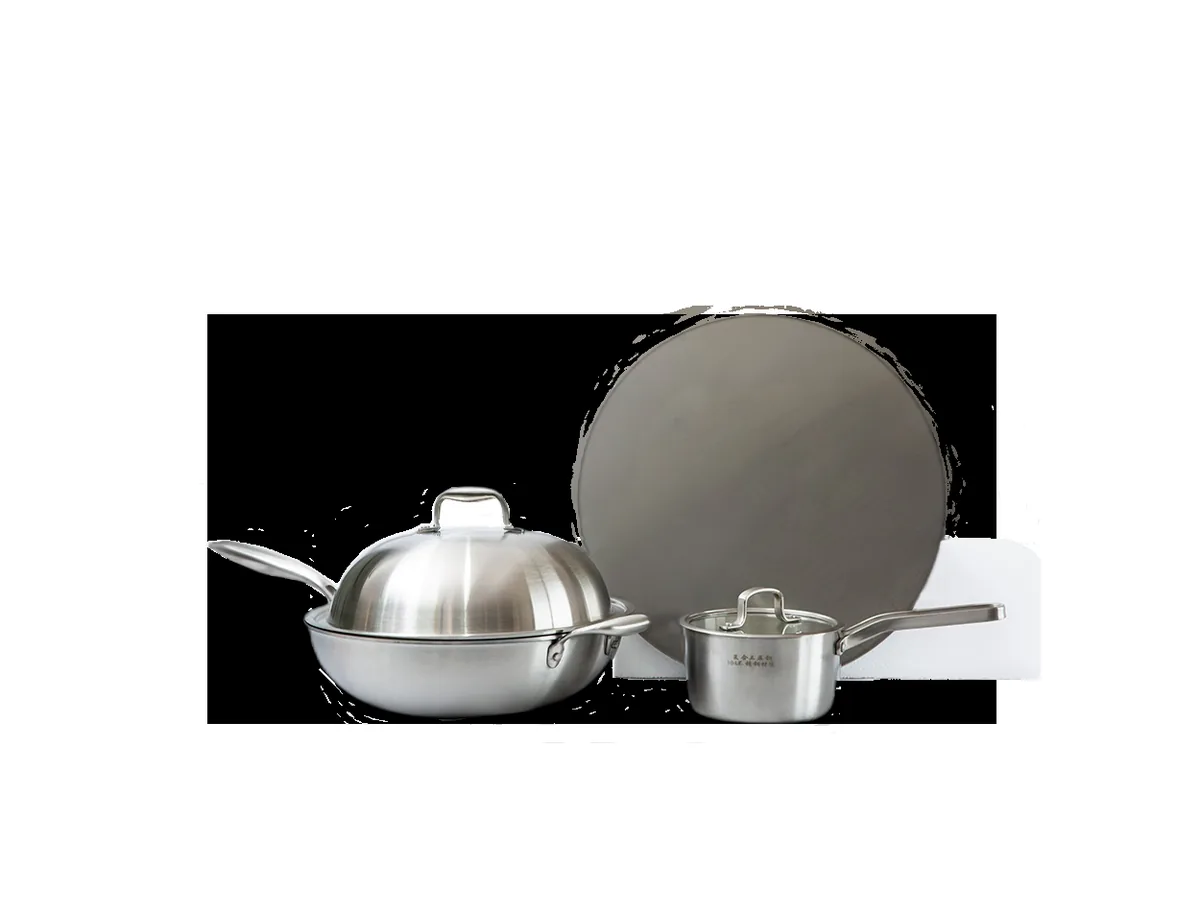
Material grade
Which stainless grade goes where in clad cookware
Two stainless faces, two different jobs. The cooking face needs corrosion resistance and a cleanable surface. The hob face needs to be magnetic. Confusing the two is the most common grade mistake in a clad specification.
At a glance
Specification at a glance
| Grade | Magnetic | Position | Why |
|---|---|---|---|
| SUS304 | Very weakly | Cooking face | Food contact, corrosion, cleaning |
| SUS316L | Very weakly | Cooking face, premium | Chloride and pitting resistance |
| SUS430 | Yes | Hob face | Induction coupling at lower cost |
| SUS439 | Yes | Hob face, alternative | Stabilised, better formability |
304: the cooking face default
SUS304 is the austenitic stainless that most cookware ranges specify for the food-contact surface. It resists corrosion in normal cooking, cleans well and takes a polish or a brush finish. It is also the grade for which most food-contact and ROHS documentation is written.
Its weakness in this application is magnetic: annealed 304 couples poorly with an induction coil, so it is the wrong choice for the hob face of an induction pan.
316L: the higher grade option
SUS316L adds molybdenum, which improves resistance to chlorides and to pitting. Cookware makers specify it for premium ranges, for commercial kitchens and where the buyer's customer requires it in the specification.
The cost is higher and the documentation set is the same shape as 304. On a domestic pan used normally, 304 is usually sufficient; 316L earns its price where the corrosion environment is genuinely harsher.
430: the magnetic hob face
SUS430 is a ferritic stainless, magnetic, and cheaper than a 300-series grade. That combination makes it the standard hob face for induction cookware: it couples with the coil and it does not need to be a cooking surface.
Because it is ferritic, it has lower corrosion resistance than 304. That does not matter on the outside of a pan base, but it is why 430 is not used as the cooking face.
439: the stabilised alternative
SUS439 is a stabilised ferritic grade, also magnetic, with better resistance to intergranular corrosion than 430 and better formability. Where a buyer's specification calls for it, or where the base sees more aggressive cleaning, 439 appears as the hob face instead of 430.
The plant holds ROHS, REACH and food-contact documentation for 439 alongside 430, which makes the substitution straightforward when a customer requires it.
Questions
Common questions
Can the cooking face be 430?
Not for normal cookware. 430 is ferritic with lower corrosion resistance, and it is used on the hob face where that does not matter.
Is 316L worth the extra cost?
For premium ranges, commercial use or a customer specification that requires it. For a normal domestic pan, 304 is usually enough.
Why not use 304 on both faces?
Because it is barely magnetic, so an induction pan built that way couples poorly with the coil. That is the reason for a 430 or 439 face.
Do you supply 439?
439 appears in the plant's test documentation for ROHS, REACH and food contact. Ask for it in the enquiry and availability for the structure is confirmed.
Which grade needs which report?
ROHS covers 304, 430, 439, 1050 and 3003; REACH covers 430, 439, 1050 and 3003; food-contact testing covers 304, 430, 439 and 3003.