
Technical
Surface finish: what Ra tells you, and what it does not
Ra is one number describing a surface that has many. It is useful when it is specified with the process, and misleading when it is specified alone.
At a glance
Specification at a glance
| Finish | Ra (reference) | Look | Care |
|---|---|---|---|
| Mill finish | 0.5 to 1.0 | Matte, faint roll direction | Needs polishing before sale, or sold as a working surface |
| Brushed | 0.2 to 0.8 | Directional grain | Hides scratches better than mirror |
| Satin | 0.2 to 0.4 | Even soft sheen | The common retail finish |
| Mirror | below 0.1 | Reflective | Shows every mark; needs care instructions |
| Embossed | pattern dominant | Patterned | Pattern depth matters more than Ra |
| Etched | pattern dominant | Matte against bright | Avoid abrasive polish |
What Ra actually measures
Ra is the arithmetic average of the profile deviations over a measured length. Two surfaces with the same Ra can look and feel completely different, because Ra ignores the spacing and the direction of the peaks. That is why a brushed and a satin face with similar Ra values read differently in the hand and in a photograph.
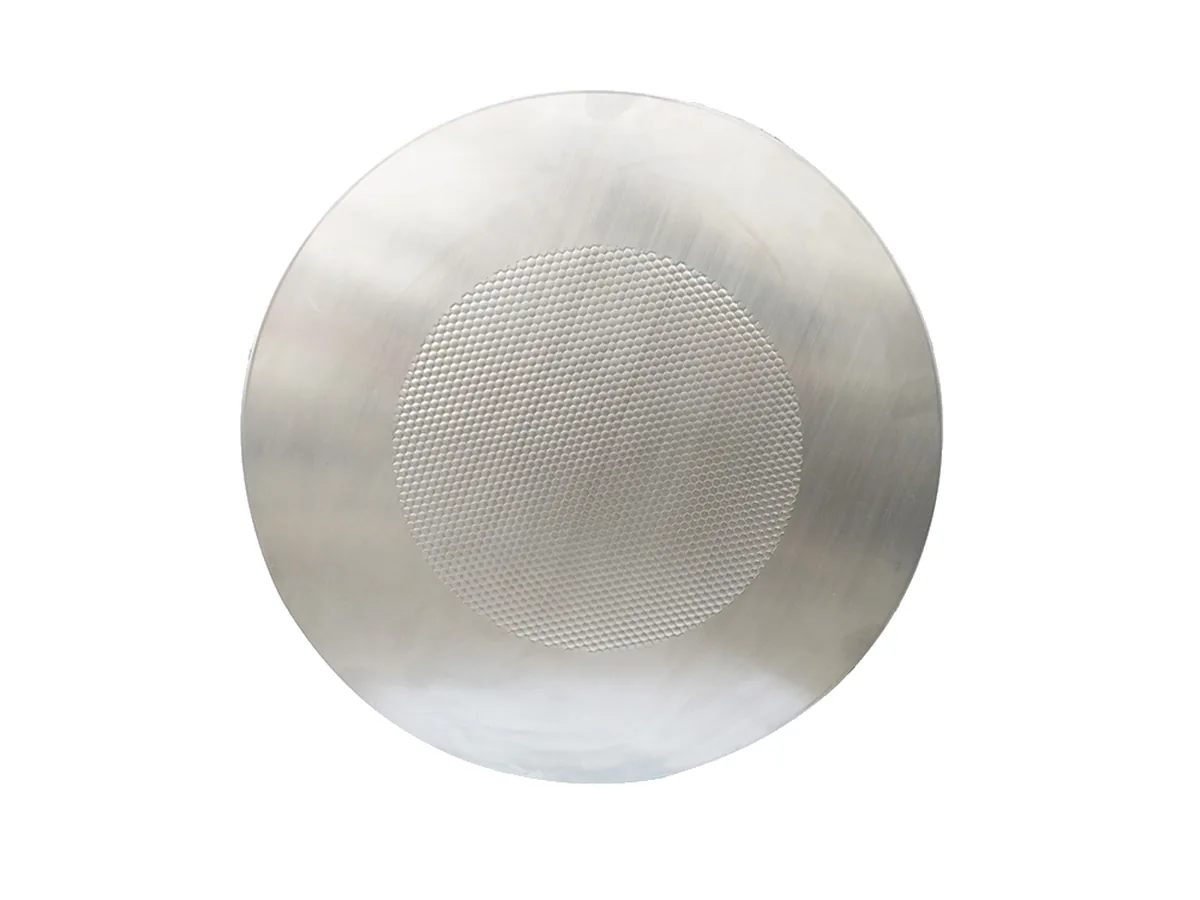
Direction of the grain
Brushing leaves a direction, and a pan is round, so the grain runs across the face in a way that either follows the form or fights it. Buyers who specify brushing should specify the direction relative to the pan, not just the Ra.
Finish, release and cleaning
A rougher face holds oil in the valleys and can feel less sticky at low heat; a mirror face gives the cleanest release when the pan is hot enough. Neither changes the fundamental rule: release depends on temperature and on the food, not on the polish.
For cleaning, a brushed face hides scuffs and a mirror face shows them, which is why a mirror pan needs care instructions in the box.
Specifying a repeatable finish
Write the process (brushed, satin, mirror, embossed, etched), the Ra range with the instrument, the direction where relevant, and an approved sample. Then keep the sample. Finish is the parameter most often argued about and least often defined, and a retained sample ends the argument in one comparison.
Questions
Common questions
What Ra is a normal frying pan?
Most retail finishes sit between 0.2 and 0.8 Ra, depending on whether they are brushed, satin or mirror. Those are reference values; the approved sample is what governs.
Does a rougher surface make a pan non-stick?
It changes how oil behaves but does not make the pan non-stick. Release depends mainly on temperature control.
Can the finish be applied after forming?
Polishing and brushing are normally done after forming by the pan maker. The material is supplied with a mill, brushed or patterned face.
Why do two suppliers quote different Ra for the same name?
Because "satin" is not a measurement. Specify Ra with the instrument and the measuring direction, and approve a sample.
Does finish affect corrosion?
A rougher surface holds residue and moisture more readily, which can promote staining if the pan is left wet. It is a small effect compared with the grade choice.