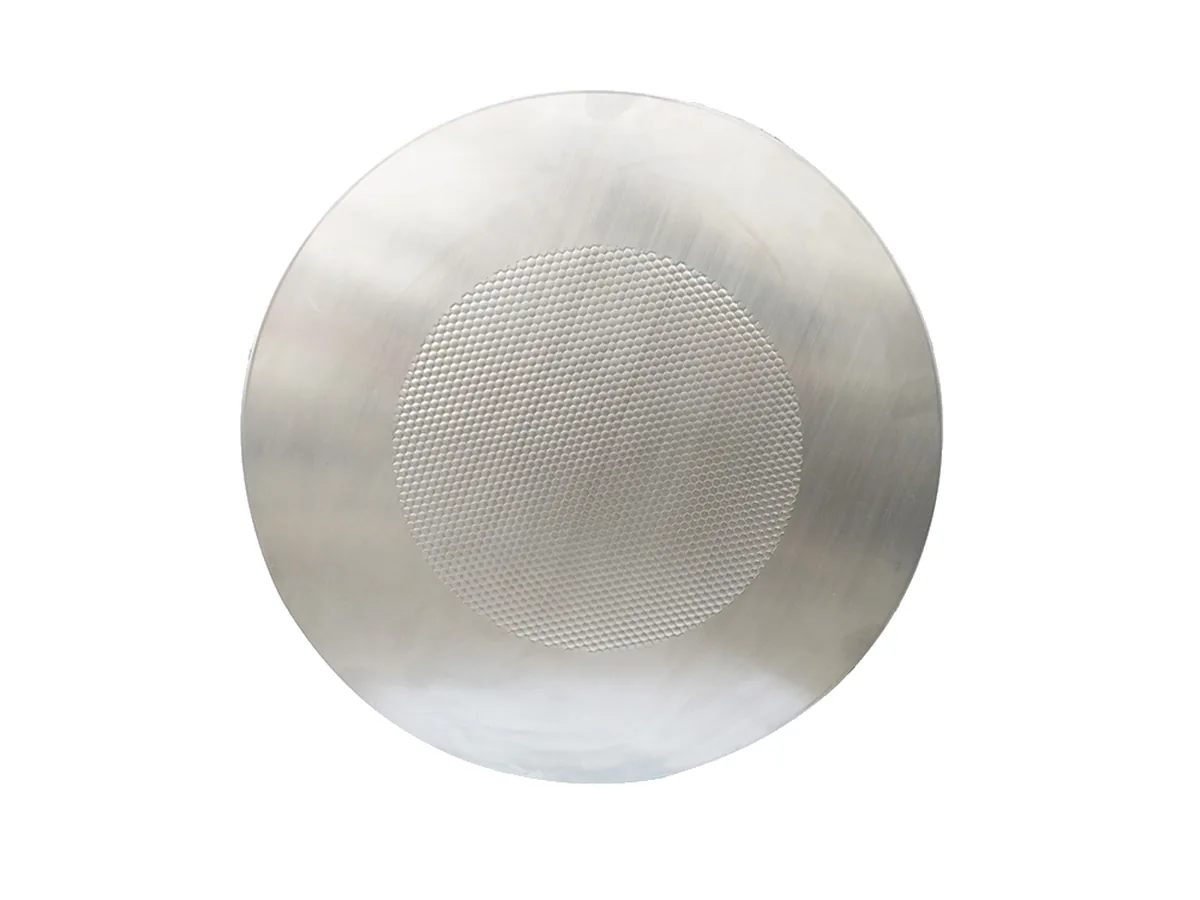
Embossed and etched surfaces: two processes, two failure modes
Both put a pattern on the cooking face, and buyers describe them interchangeably. They are different processes with different tooling, different durability and different costs.
At a glance
Specification at a glance
| Item | Embossed | Etched |
|---|---|---|
| How the pattern is made | Rolled into the face with a patterned roll, then bonded | Mask applied, exposed areas etched, mask stripped |
| Typical depth (reference) | 0.05 to 0.30 mm | 0.02 to 0.10 mm |
| Pattern range | Regular geometric repeats, honeycomb, diamond | Finer motifs, logos, text, photographic detail |
| Tooling | A patterned roll; pattern fixed for its life | A mask per design; changeable between runs |
| Effect of polishing | Flattens the peaks; pattern fades | Removes the etched layer where polished |
| Cost driver | Roll cost amortised over volume | Mask cost per design, plus chemical handling |
| Best for | High-volume ranges sold unpolished | Logos, low-volume designs, fine detail |
The process decides the durability
Embossing deforms the stainless face itself, so the pattern is the metal. It survives handling, scouring and normal use, and it only fades when someone polishes the face flat. Etching removes metal where the mask opens, leaving a shallow relief that reads as a matte pattern against a bright field.
That difference decides the use case: embossed for a working surface, etched for a look that is usually protected by not polishing it.
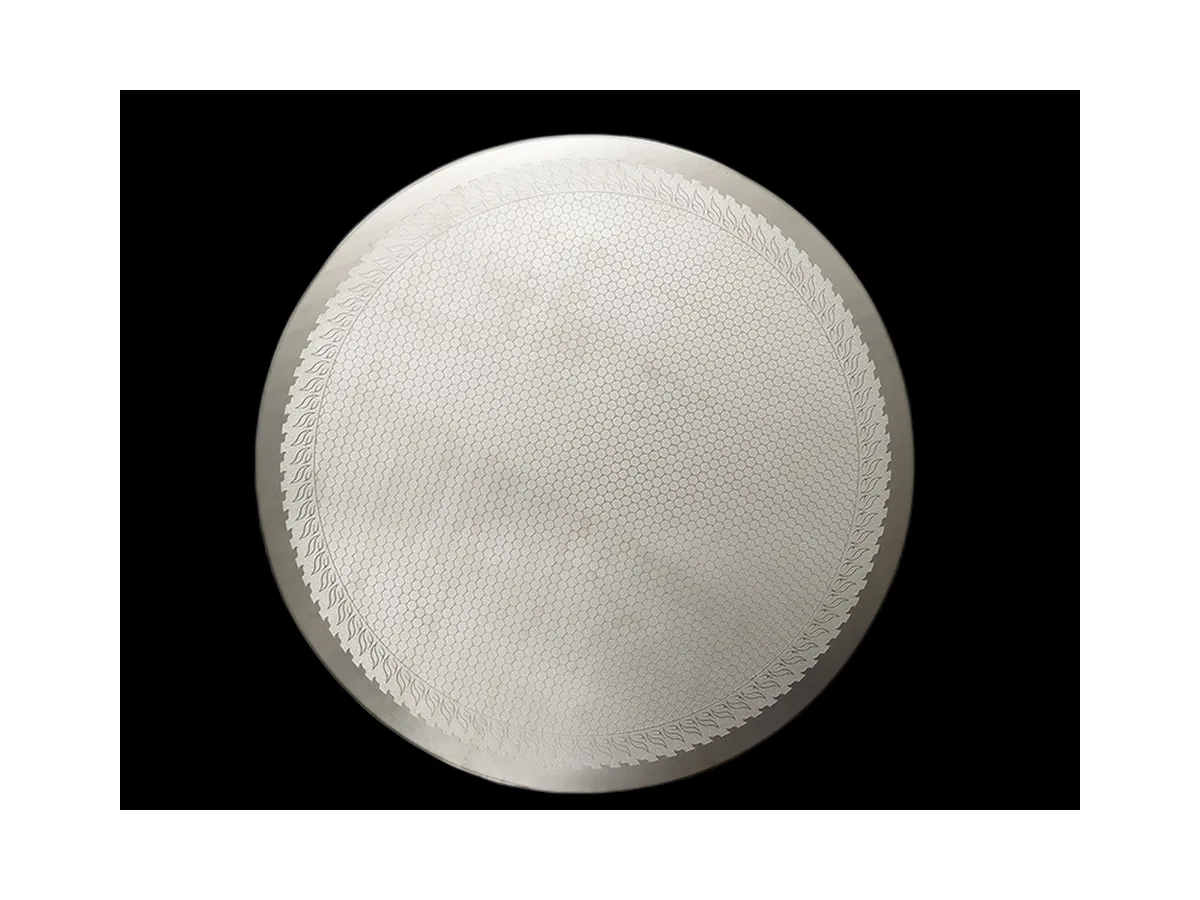
What happens in the press
Both patterns are applied to the sheet before the pan is formed, so both get stretched. A deep draw flattens the pattern where the material stretches most, which is normally the wall rather than the base. If the pattern must stay crisp into the wall, the depth and the draw ratio have to be agreed together, not separately.
This is also why pattern samples are approved on a formed part, not on a flat coupon.
Hygiene and cleaning arguments
Patterns are often sold as improving release and reducing sticking, and at the scale of a real pattern they do change how oil behaves. What they do not do is make a pan non-stick: the effect is small compared with temperature control and surface finish.
On cleaning, a deeper embossed pattern traps more residue than a fine etch, and a fine etch is harder to scrub without dulling. Both are decisions the buyer should make with the dishwasher specification in hand.
Induction and the outer face
Patterns are normally applied to the cooking face. If the design also patterns the base, the 430 face is still the induction face and the pattern must not reduce the contact area enough to change hob performance. Ask for the pattern depth on the base separately from the face.
What to put in the specification
Name the process (embossed or etched), the pattern reference, the depth range, which face it is on, whether the pan is polished after forming, and the sample that was approved. Without the process named, a supplier may deliver the cheaper of the two and still meet the drawing.
Questions
Common questions
Which is more durable, embossed or etched?
Embossed, because the pattern is formed in the metal rather than cut into it. Etched relief is shallower and disappears under polishing.
Can etched patterns carry a logo?
Yes, and that is one of their advantages: a mask can carry fine detail and text that a roll cannot reproduce economically at low volume.
Does a pattern make the pan non-stick?
No. It changes how oil spreads and can reduce sticking slightly, but release depends mainly on temperature control and surface finish.
Is the pattern still visible after deep drawing?
On the base, yes. On the wall it flattens as the material stretches, so the draw ratio and pattern depth have to be agreed together.
Do both processes cost the same?
No. Embossing carries a roll cost amortised over volume; etching carries a mask cost per design plus chemical handling, which favours small runs and detailed motifs.