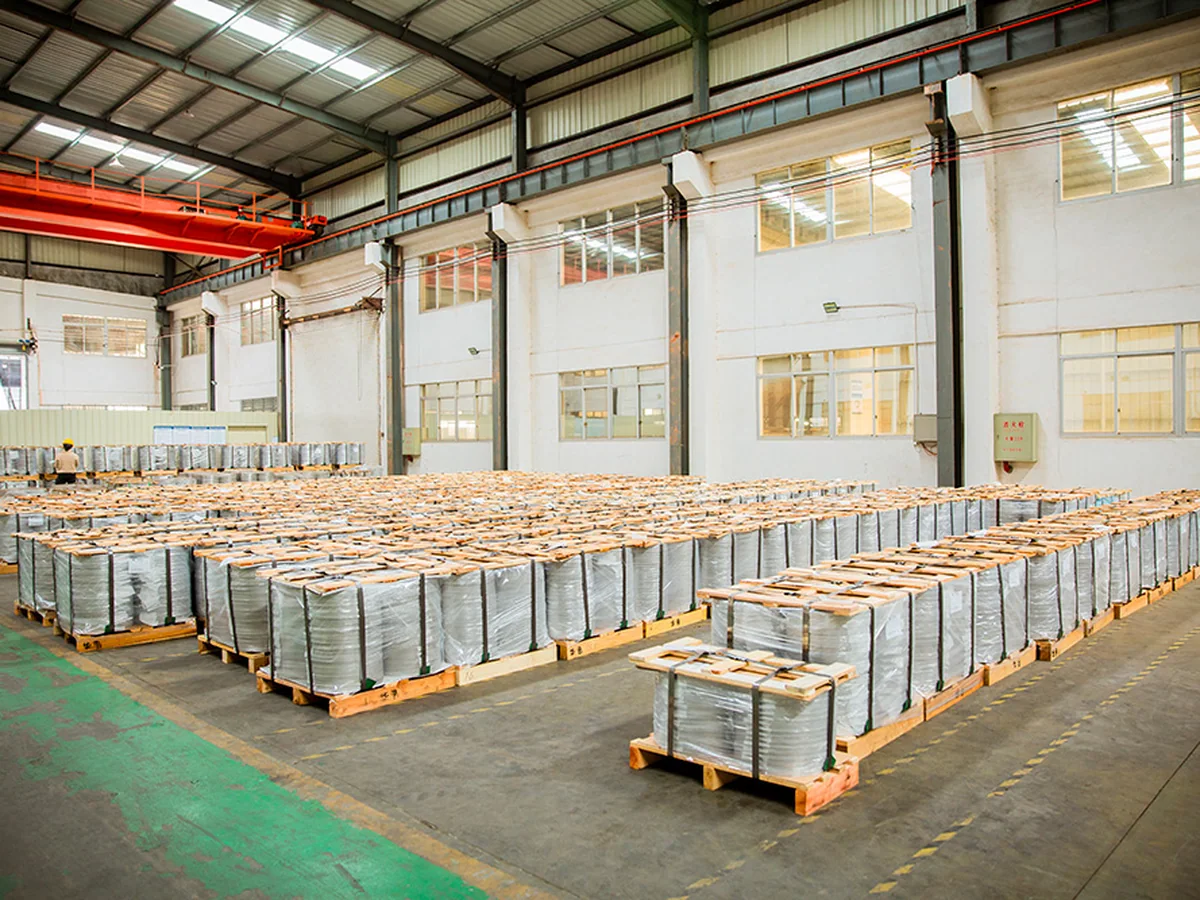
MOQ: why the number moves, and how to plan a first order
There is no single minimum order for clad metal, because the minimum is set by what has to be set up: a structure, a roll, a mask, a cutting route. Understanding which of those applies to your order explains the number.
At a glance
Specification at a glance
| What you are ordering | What sets the minimum | How to reduce it |
|---|---|---|
| Standard structure from stock | Cutting and packing time | Accept the stock gauge and surface |
| Standard structure, new gauge | A bonding run | Join an existing run schedule |
| Custom structure | A dedicated bonding run plus yield loss | Buy the trial quantity from that run |
| Embossed surface | The patterned roll | Use an existing pattern |
| Etched surface | The mask | Combine designs on one sheet if the parts allow |
| Special diameter | Blanking tooling | Choose a diameter close to stock tooling |
Why the minimum is not a policy
A supplier quoting a minimum is quoting the point at which the setup is recovered. For a stock structure that point is low, because the only setup is cutting. For a new structure it is high, because a bonding run has a fixed cost in pass count, yield loss at head and tail, and quality testing.
That is why the same supplier can accept 500 kg of one thing and require 10 tonnes of another without being inconsistent.
Splitting a first order
The usual compromise is a trial quantity from a scheduled run of the same structure, followed by a container once the trial is approved. It keeps the first commitment small without asking the supplier to interrupt the line for a dedicated run.
Where buyers overpay
Three habits raise the effective minimum: a bespoke diameter when a stock one would do, a bespoke pattern for a range that could share an existing one, and a structure that exists only on paper because nobody checked whether a similar one is already running.
Asking "what is close to this that you already make?" is the cheapest question in the process.
What to tell the supplier
Give the first order and the annual volume separately, and say what the annual volume depends on. A supplier pricing a 20-tonne annual programme differently from a one-off 2-tonne order is normal and useful; a supplier who cannot say which is which is not quoting seriously.
Questions
Common questions
What is your minimum order?
It depends on the structure, the form and whether tooling is involved, so it is quoted per enquiry rather than published as one number.
Can I order a trial quantity?
Yes, normally from a scheduled run of the same structure. The trial quantity and its price are quoted with the enquiry.
Does a larger order always get a better price?
Generally, because setup is spread wider. The step changes come at run size and at container size, not smoothly with tonnage.
Can I mix structures in one order?
Usually yes, if each structure is available in a compatible run. Mixing adds setup, which shows in the price.
Do you keep stock of standard structures?
Some standard structures and gauges are cut from stock. Availability is confirmed per enquiry, because it changes weekly.