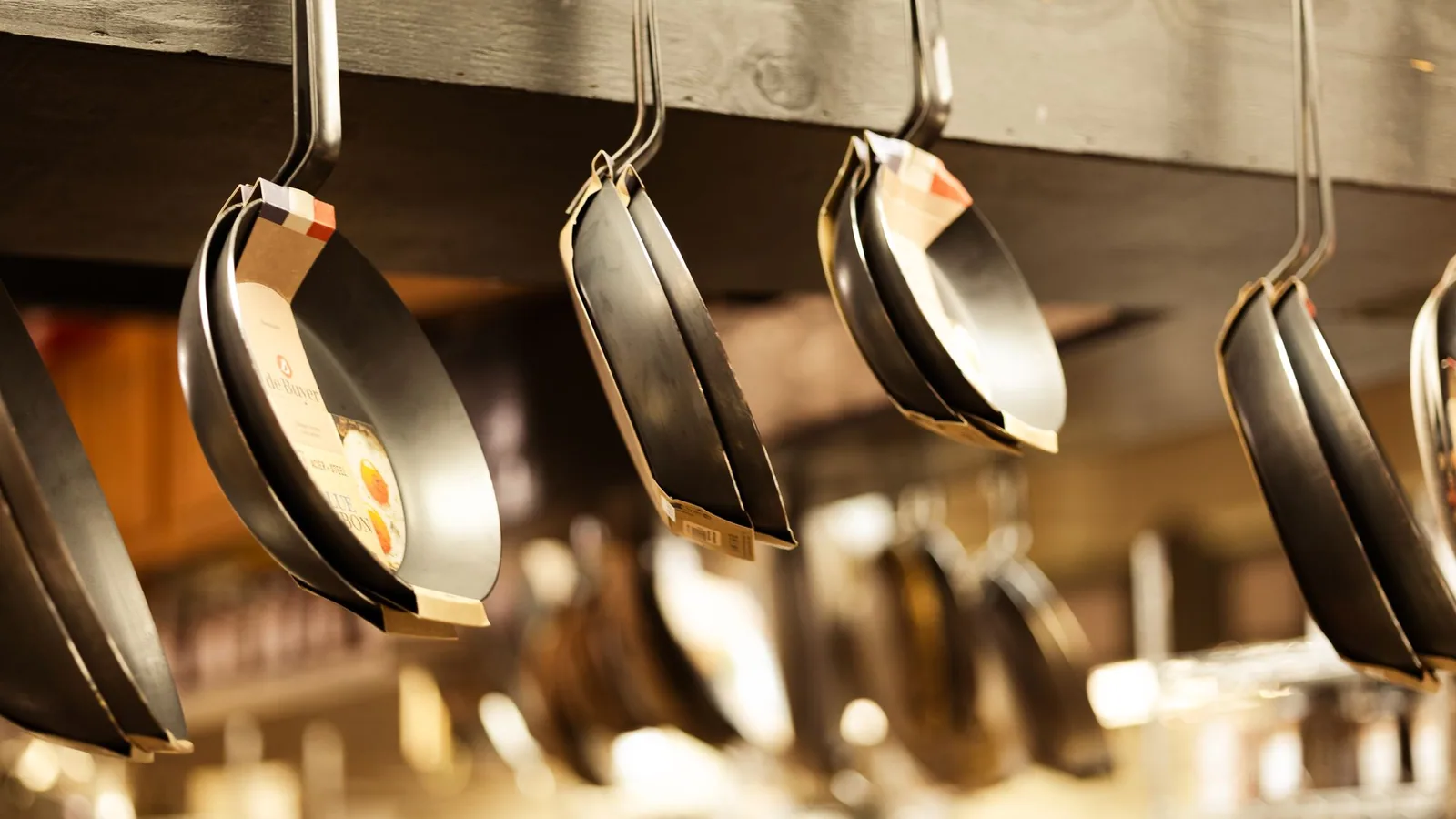
Clad material in commercial kitchens
Professional kitchens punish material in ways a home kitchen never does: hours at temperature, metal tools, and cleaning cycles that strip a finish. The specification shifts accordingly.
At a glance
Specification at a glance
| Equipment | Why clad | Specification note |
|---|---|---|
| Fry pans and saute pans | Even heat under a crowded pan | Thicker core than home equivalents |
| Stock pots | Heat spread up the wall, no scorching | Wall clad matters, not only the base |
| Heat spread plates | Uniform temperature across a griddle | Flatness and thermal contact are critical |
| Chafing dish bases | Gentle even warming | Moderate gauge, stable flatness |
| Bain-marie inserts | Even gentle heat | Often single-layer stainless; clad only where needed |
| Display cooking | Appearance plus performance | Finish and edge treatment |
Duty cycle is the difference
A home pan heats twice a day. A professional pan heats, cooks, is washed and reheats twenty times. Thermal cycling accumulates, and the failures that appear in a home pan after two years appear in a professional pan in two months. Thicker cores and better edge treatment buy service life, not just evenness.
Where clad is not the answer
Much commercial equipment is single-layer stainless because the job is containment, not heat spreading. A bain-marie insert does not need a clad base. Specifying clad everywhere raises cost without raising performance, which is a common mistake in tenders.
Flatness under a griddle
A heat spread plate that is not flat has an air gap, and an air gap is a hot spot. For plates, flatness is the specification rather than a supporting property, and it has to be measured hot as well as cold.
Repairability matters more than finish
A professional pan is scrubbed with abrasives. A mirror finish is a liability; a satin or unpolished surface survives longer and can be restored. The best finish here is the one that can be brought back with a scouring pad.
What to specify
Structure, gauge, flatness hot and cold, edge treatment, surface that can be restored, and the cleaning regime it must survive. Then the volume, because professional ranges are bought in multiples, not singles.
Questions
Common questions
Is thicker always better in a professional kitchen?
Up to a point. Thicker holds heat and resists warping, but becomes heavy for a line cook working a station all service.
Do professional pans need a clad wall?
For stock pots, yes: the wall conducts heat upward. For shallow pans the base does most of the work.
Which finish lasts longest?
A satin or unpolished surface that can be restored with a pad. Mirror finishes show every scratch.
Can you supply heat spread plates?
Clad sheet can be supplied for plates, with flatness specified hot and cold. Design verification for the equipment stays with its manufacturer.
What volume makes a custom structure worthwhile?
It is quoted per project. Custom tooling and special gauges need a volume that amortises them, which is usually well above a single kitchen fit-out.