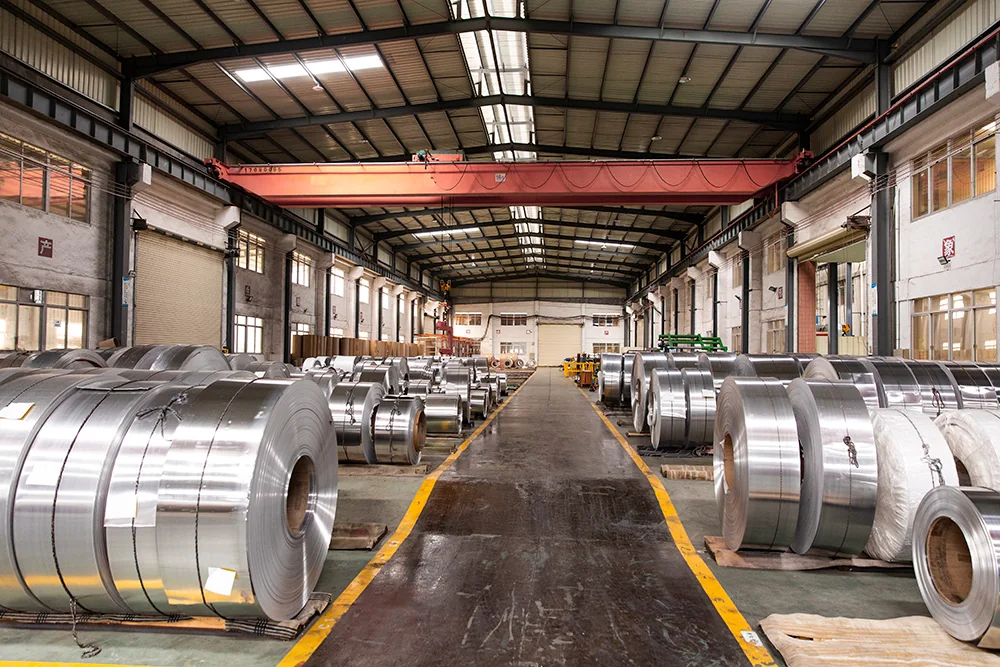
Strip, coil or sheet: choosing the form
The same material in a different form changes the yield, the handling, the tooling and the price. Buying the wrong form is one of the quiet costs in a cookware plant.
At a glance
Specification at a glance
| Form | Best for | Watch out for |
|---|---|---|
| Coil | High volume, continuous press lines | Coil weight, inner diameter, edge condition, storage |
| Cut strip | Medium volume, batch production | Length tolerance and stacking |
| Sheet | Blanks, trays, small runs | Flatness and edge burr |
| Circle | Direct press feed for round parts | Nest and diameter tolerance |
| Blanks | Non-round parts | Corner detail and squareness |
The form follows the equipment
A plant with a decoiler and a coil-fed line should not be buying sheets: it pays for cutting and handling twice. A plant with hand-fed presses should not be buying coils: it needs a straightener and a shear it may not have.

Yield is where the money is
A coil cut to the width the part needs leaves a trim edge at the slitter, not a web across a sheet. In a nested circle operation the difference between buying sheet and buying strip cut to width can be several percent of material, which compounds at every ton.
Handling cost is real
Sheets are easy to store and to count and hard to automate. Coils are the opposite. The right answer for a small plant is often cut strip: no decoiler, no sheet handling, and the slitter does the work.
What to state when ordering strip
Width with tolerance, thickness, coil weight range, inner diameter, edge condition (slit or mill edge), surface protection and the direction of the pattern. A pattern rolled along the coil behaves differently in the press than one rolled across it.
What to state when ordering sheet
Size with tolerance, flatness, edge condition and stacking. Sheet flatness after cutting is the item most often left off a drawing and most often disputed on arrival.
Questions
Common questions
Is coil cheaper than sheet?
Per kilo, usually, because there is less cutting and less handling. Whether it is cheaper for your plant depends on whether you can process it.
What coil weight can you supply?
It is agreed per order against your decoiler and crane. State the maximum your handling allows.
Can you slit to my width?
Yes. Width, tolerance and edge condition are stated on the order.
Does pattern direction matter?
Yes. A rolled pattern has a direction, and feeding it across the die instead of along it changes how it looks after forming.
Which form suits a startup plant?
Cut strip. It avoids the decoiler investment and keeps handling simple while volumes are still small.